
Thursday, March 3, 2016

On Coffee

When I first came to Russia in 1994, I was a confirmed coffee head. At that time, coffee meant Pele, a canned instant coffee that had the same relative components of coffee in the way Tang had the same relative components to orange juice.  In other words, there were only vague similarities. It wasn't that the Russians didn't like coffee (that trend would come and go later on as a matter of principle as per the odd mechanisms of the Russian consumer mentality) but that they had just never had it. Most Russians first encounter with Pele happened in circumstances of dearth - at a kiosk in a railway station where there was no tea, at a friends house in the morning after a late night and so on. Pele was not hard to find in stores. I had it as a coffee substitute pretty regularly but without copious amounts of sugar and milk, often also difficult to marshal all at once at any given breakfast table, it was a last resort. I wasn't in any way against drinking tea and because everybody else did, tea became my drink of choice by default. I never really had coffee withdrawals. It was a smooth transition.

After coming from the Netherlands to live in Moscow permanently at the turn of the century, I had coffee in my blood. The Dutch do coffee well and I was a pot a day coffee head. In Moscow, corporate environments became my daily dwelling and I was pleasantly surprised that coffee - real coffee - was pretty much everywhere by that time. This is when I saw that Russians hated coffee. I had missed some kind of transition in the late 1990's when Pele had all but dissipated (its back now, by the way, with a marketing vengeance) and a plethora of instant and whole bean coffee was circulating in break rooms and offices all over. The instant coffee was better, but head and shoulders above the grey sand powder that came in metal tins in the early 1990's. Whole bean and ground coffee was available, but nobody knew how to make it. I witnessed many Russians make 'cowboy' coffee by putting expensive ground coffee in plastic cups with hot water. This didn't work and most thought it was crap because it was - when prepared like instant coffee.

The office I worked in had a drip coffee maker and whenever I started my day in our office instead of at a clients office I was the guy everybody asked to make coffee because I was the only one who could figure out how to replace yesterday's filter with a new one and brew fresh coffee. My colleagues often brewed several pots with a single filter, sometimes adding more grounds on top of the old ones.  Cleaning the pot came as a revelation. Pretty soon all the guys drank coffee but the ladies were slow to adapt. I worked there for a few years and everybody got the hang of it more or less.

Making coffee at home has gone through several phases. I had a pot with a filter on top for a while and then several incarnations of an automatic drip coffee maker. I was the only coffee drinker at home so we got the small ones that only make a single cup or two cups maximum. This got ugly when guests came over - which was frequently and I eventually invested in a full on drip coffee maker with a big 6 cup pot. Almost immediately I dropped the pot and since then I have only used French press coffee makers. At first they were expensive, but now every hypermarket has several cheap-o variants to choose from and if you break it, which you will, replacing your French press doesn't' constitute a sacrificial offering.  Now that my eldest daughter also needs coffee to function in the morning, our stand by French press is a large one that holds 4 whopping cups and is also suitable for having guests.

My work routine involves going to a local cafe to meet clients pretty regularly and as a cheap guy, I've moved from ordering cappuccinos to ordering double espressos. It started out as a more bang for the buck approach (the double espresso is cheaper than the cappuccino and  only marginally more expensive than the Americano) but now I am simply a double espresso guy. I order it with a shot of hot milk on the side. I don't take sugar. My cafe is pretty decent and so shifting to double espresso was not a major ordeal. I am pretty much a regular coffee guy at home and a hard core coffee guy in town. Having reached this equilibrium, I also like to switch up brewing methods when I'm out and about.

A friend introduced me to Turkish coffee and I was mildly enthusiastic. I was not a big fan of the dregs. Over time, I have learned that 'Turkish' not a hard and fast term and that similar methods of preparation are popular all over Southern Russia where coffee has always been more of a staple alternative to tea, even in Soviet times. Georgian coffee is also prepared in a ibrik, but the method is different - sugar is put into the coffee before brewing and the shape and mouth of the pot are designed to keep the dregs in the pot and not deposit them in your cup.  Georgian coffee is often prepared with cardamom or other spices and they don't freak out if you put milk in it.

I have been contemplating getting an ibrik pot for a while when a friend came to Russia after spending a prolonged tour in Italy. She arrived with a Bialetti 'brikka' coffee maker, a slightly modified version of the classic hexagonal shaped 1950's stove top espresso maker. She let me borrow it for a few days.  Despite following the detailed instructions rather scrupulously, I couldn't manage to produce a cup of the famous 'crema'  that the stove top coffee makers are famous for. I made several attempts, but as each experiment used the same amount of coffee I normally use for a full French press, my cheapness significantly hindered my learning curve. I managed to produce some dashing little cups of coffee that curdled the inner lining of my brain - this was also a factor in my limited ability to experiment - but I couldn't get the 'crema' to form. Besides, drinking a demitasse of rocket fuel coffee disrupted my more leisurely at home coffee routine. I like to drink coffee in the morning - several cups in fact - and I don't need my head to pop off like a champagne cork.

It was a good experiment, however, in that I have learned that I don't need espresso gear at home. 

Tuesday, November 22, 2011

On Courtesy vs Charity

I have never had a flair for fashion. In college I was called Professor and Doctor Hoffman largely because I wore sport coats and vests year round. In Russia my sport coats were less obtrusive among people my own age in the warmer months, but it the winter, which in Russia starts in November and drags on until April sometimes, I struggle because typical Russian winter clothing is simply too heavy for me and because of the indoor sauna effect in almost every Russian indoor space - if its minus ten outside, you can bet its plus 20 inside. The colder the weather, the more insane the indoor central heating. Managing the outer-garment as aspect of this thermal anomaly only became an issue for me in Russia. Adjusting my clothing to real seasons was and remains a serious financial, physical and behavioral challenge for me. Early in my experience in Russia, I had a lot of help.

One of the most amazing acts of charity I ever experienced in Russia was in 1995 when I was living in Optina Pustin. When I first came, the monks gave me a scratchy handmade woolen coat. This was a simple, short waist coat, the kind used by manual laborers on the kolkhoz. It was plain grey, with a small flared collar and four black plastic buttons - a poor imitation of a military issue design. It came with other stuff, too, mittens and a white dress shirt - all handmade. Not elegant, to be sure, but they fit and were durable. Wearing the coat, I felt very much a part of things and must have looked the part as well because, if I kept my mouth shut, fewer people asked me where I was from. I blended in.

I was informed that the coat was 2nd hand, part of a very small collection of worldly possessions left behind by a certain monk Lazar, who had died only recently before I arrived at the monastery. Lazar was one of many who had been working at the Chernobyl Nuclear Facility in the Ukraine in 1986 when they had the meltdown. There simply wasn't much more information on the man - he became Orthodox as a result of his condemned state and when the cancer progressed to a certain point in the 1990's, he departed for Optina and became a simple monk in the hopes to spend his remaining time on earth in repentance. He died in the summer of 1994. He was in his mid 40's.

This coat was my treasure. It was the perfect coat for me. Warm, but not super warm and not at all heavy. It was the kind of coat you took off when coming into a building but could leave on in Church if is wasn't that hot. It had pockets. I literally wore the jacket threadbare and after I was married – 6 years later - my wife, not caring a fig about its sentimental value and seeing that is really not much more than a dirty rag, threw it out. I can't blame her, but I would still have liked to have kept it.

The following winter of my first year in Russia, I became acquainted with Hireodeacon Iliador, a massive grizzled Georgian man with a hook nose who was reputed to have been a notorious bandit haunting the area around the monastery before it was returned to the Church in 1988. He became a monk early in the history of the re-opened monastery and before long he became a deacon. He had the strongest, most majestic voice I have ever heard in church. Though in personal communication it was clear he had a pronounced lisp, when he bellowed out the litanies during services this defect somehow enhanced the musicality of his voice. Fully decked out in his Church vestments, he resembled nothing short of a Georgian king. His voice made me weep, especially when he sang the prokimenon during vespers on Sunday evening: 'the Lord is enthroned, He is clothed with Majesty' - I felt and still feel that I am not on earth when I hear him erupt with this solemn but triumphant point in the All night Vigil.

Fr. Iliador was known for his generosity and he always had something in the deep pockets of his podrasnik. Toys, candy, money, prosphora, fruit, tools, handy items and unusual items – he seemed to be a bottomless pit of stuff. He was always giving something to everyone, to strangers and friends. He would often give me a bag of candy or a candle or prosphora. I can't remember the exact occasion, but sometime after the Nativity season, where there was still heavy snow, he gave me a magnificent black overcoat. He called me to follow him to his cell, a place where pilgrims at the monastery were not supposed to be except in special circumstances like for obedience or to get a blessing. He went into his cell, rummaged and returned with this fantastic black Russian winter coat, the heaviest I have ever worn and virtually unused. It had a silk lining and deep outer as well as inner pockets. It was the kind of coat that I had seen on lay priests and, having long hair and scruffy beard myself, I was very often mistaken for a priest when I wore it. I have never seen winter coats like these in stores, but it was extremely well made and I couldn't tell if it was a product of mass manufacture or the work of a professional tailor. The coat was so heavy that I could dress very lightly underneath, without layers, and still not even feel the wind. It must have been 5 cm thick. It was a bit uncomfortable indoors because taking it off was like removing armor and as it didn't fold easily, it was sometimes hard to find a place to put it if there wasn't a coat rack. It was easily the most luxurious item of clothing I have ever possessed. It totally changed my perception of the Russian winter and my feeling of acceptance in Russian society, which moved from being invisibly enumerated among the locals to loosing my title as the anonymous 'maladoy chelovek' (young man) and gaining the formal (plural) personal pronoun 'vyi' – a common sign of respect for adults opposed to the more familiar 'ti' used by peers or adults addressing youth. I wore the coat for the remainder of the winter and lugged it around when I returned to Moscow. When I left Russia in the summer of 1995, I couldn't take it with me because it was so huge I had no place for it in my luggage. I gave it away. I cannot speak of the number of times I have kicked myself for this, nor how I wish I had such a coat now.

Material things flowed very freely in the monastery, but less so in Moscow. Still, the generosity of Russians is never to be underestimated. I have found charity in Moscow to be effulgent in a different way, partly because I have established myself and perhaps no longer look like an obvious candidate for charity. My integration has also hardened me a bit, too. I am less vulnerable to 'attacks' of goodwill and the fascination with 'white elephants' that are so often traded in acts of spontaneous generosity has waned. Having acquired the familiar trappings of routine and responsibility, I am also simply less open to the primordial depth and earnestness of contact with strangers in Russia. I no longer see how special these moments are, I think about my personal space and my time as if they were, in fact, mine. There is, for sure, an patent aggressive element to contact among strangers in Russia that is managed by common courtesy and higher levels of personal shame in other countries. You can ask a stranger for the time, but your average Russian might just as often start a philosophical conversation. Mental illness not included. This goodwill without a seat belt often throws me off balance. I used to find it fascinating to engage unknown people on issues of love and culture in the train, but now I feel awkward. Furthermore, I simply don't know how to receive unwanted gifts very graciously. One would think this would be a talent that didn't need to be exercised very often – but in Russia such a social skill is a staple of everyday tact.

I see our priests in Church at the analogion confessing the huddled masses. They are literally getting gifts in one hand and passing them out with the other. They don't even look. I recall the story from the life of Archbishop John where a wealthy parishioner wanted to make a donation to Vladika's charity programs and gave a substantial sum in an envelope to the archbishop. The man observed that Archbishop John never even looked at the envelope but simply handed it to the very next person, a poor woman, who had come to get his blessing. I have witnessed and even been the subject of such charity here in Russia. But interaction with ordinary people on this level can nevertheless be quite a culture shock, even for this guest who has been here for more than 10 years now.

It is deep fall in Moscow now. The ground has frozen and patches of stubborn snow refuse to melt in the clear afternoon sun. For me, it is paradisiacal weather - warm enough not to require a winter coats but cool enough to be a refreshing break from the stifling heat of indoor environments. I go to church wearing (surprise) a sport coat. With the local villains all bundled up in Antarctic fervor, I naturally get looks from people on the street. It’s as if I am walking about naked or with a sign on my head. Sometimes it’s funny. Sometimes it’s just weird and hard to bear.

I was accosted the other day outside our parish church by a woman who insisted I was cold and demanded I take some socks she magically happened to have in her purse. Surreal moments like this require cool-headedness. The bizarre context of the situation caught me off guard and as the difference in spoken Russian between the bewildered inquisitive 'Aren't you cold?' and the incredulous accusation, 'YOU ARE COLD NOW!' can only to be determined by the subtlest variation in tone and inflection, I was duly flummoxed. To those unprepared for the authoritative Russian approach to concern for their fellow man, the two phrases are, grammatically speaking and word for word, identical. Instead of just saying no, I'm fine and I don't need the socks, thank you, I let myself be overwhelmed by the annoying Russian paternalism that grants moral authority to those who would be your benefactor.

I asked the woman in the unabashedly annoyed voice of a frustrated foreigner if she thought I was a homeless person.

She paused to consider her answer. I think she initially assumed I was a homeless person but reconsidered this opinion when it became clear I was a foreigner. She was unprepared, I think, for my resistance to her offer.

She repeated her insistence that I was cold (now it was clearly not a question but a statement of fact) and wagged socks at me, insisting I take them. ''Really, I have lots of them. Its no trouble.'' I still had the opportunity to politely refuse, but instead indignation took over when annoyance left off and I mumbled something in my less than articulate Russian about my capacity to know if I was warm or cold myself, without the advice my adopted mother on the street. We both entered the church a little self conscious about our physical proximity to each other in a house of God.

Of course, I thought to apologize – I do sometimes. I was just so mentally eviscerated by the Russian approach to concern for others, which however well intended is just plain aggressive at times. I felt very much like a object and not a person and I was both shocked and aware of my misplaced cultural sensitivity at the same time. As an American, I am so used to maintaining a threshold of perceived independence and right to my opinion that when someone crosses this invisible line, I allow myself to feel violated in a way I know is not intended or even understood by those who step over the line. It is, after all, a rather deranged proposition to feel threatened by charity. Yet I continue to insist that common courtesy and consideration for the inevitable differences of opinion on matters of personal comfort are also forms of charity, however undervalued these notions are in Russian society. I keep telling myself that I am a guest in Russia and that it is I who must adapt, but some dispositions are too deep to be moved. In preserving my fake inner world, I miss opportunities to connect.

I am reminded of other themes from the life of Archbishop John, who was a foreigner in three different countries for most life as a bishop and archbishop. He was often subject to the indignant attitude of fellow clergy (invariably Russians) when he didn't wear shoes or went inappropriately under dressed in cold weather, which he did often. He was known to growl a bit at these perfunctory foibles. In one incident in which fellow hierarchy demanded that he wear shoes, he simply carried a pair around with him but didn't put them on his feet. When they later would ask him where his shoes were, he would produce them and show that he indeed had them (the word for 'wear' and 'carry' is the same in Russian).

These stories make me smile and I allow myself the illicit pleasure of identifying myself with Archbishop John in this regard, however dissimilar we are in our manner of life and disposition of soul. Archbishop John was a saint, of course, and the flames of Divine love in his heart were no doubt stoked by greater pains than the mere stings of ants. But for me there is real anguish of soul, and I see that however elementary, my self induced suffering is real enough. More than just ingratitude, it is hurtful to others. Archbishop John was perhaps mildly irritated with the focus of his fellow clergymen on the mundane affairs of fashion, but I am embarrassed to behave so rudely to people who are after all just being nice. I hope someday I can just take the socks without grumbling. It won't make me a saint to accept the gruff but well intended kindness of Russians, but it will take a little humble pie to go down without the salt of flippant commentary. I hope the Lord will accept this as a sacrifice on the altar of love, for my sake. I can't possibly entertain the hope that my Russian hosts will understand such a disposition.

Thursday, May 20, 2010

The Guitar Player

I went to high school with a young rocker, V.A., who had considerable influence on me. I felt the impact of his personality and musical ability less in my own attitude and musical ability that in my understanding of relationships and what it is I was looking for in friends and heroes. I saw him as a creative peer and was drawn to befriend him because of this, but in reality our creative powers were really not that similar. What struck me most was his confidence, which as a teenager was remarkable. It remains unclear whether his confidence stemmed from his prodigy-like talent or if the talent was unlocked by his disarming confidence. I had hopes it was the latter and that I would discover how to unlock my own dormant musical ability by leveraging my own confidence, which was thin but more developed than many of my peers. Our friendship was brief and intense, not the least because I wasn't much of a musician, but in that brief space I gained more front and center insight from him than from any other another person to that point.

I recently watch a program in which Neil Peart, one of my intellectual idols from the same time, was discussing role models and whether society was 'getting dumber.' He was on a talk show. He commented that he didn't think human nature changed so much as the social environments against which we measure ourselves and that people look up to heroes and role models in the media and literature because they want to be smarter or better, whereas the obsession with stupid television is not a result of society having become dumber, but that we are less threatened by examples of people who are clearly not as smart as we are. We get affirmation through negative stereotypes, seeing that we are smarter than, say, Beavis and Butt Head, or at least not as dumb as many others who have prominent roles in the abstract world of media. I think this speaks volumes about how our identity take shape when we are young including our the social groups we hang out with and the influences that touch us from outside our immediate experience.

Young people naturally have a desire for an elevating experience, for the opportunity to enter into the world of a person or group that is obviously smarter than we are to somehow become smarter or better ourselves. In traditional societies, such experiences are often forced upon us when we enter adulthood. In our contemporary society, the voluntary nature of this exchange is highlighted. To seek out intelligent or 'high culture' requires a bit of self abnegation, a kind of vulnerability that opens us up to thinking and reflecting. It is the exact opposite of seeking identity with the like minded or security with those who are clearly below us in some way, even if only though prejudice and insularity. Because our fragmented society with a plurality of values and ethics is less capable of helping individuals meet basic self esteem needs, affirming ourselves against the dummies plays an absurdly important role in both forming (and arresting the formation) of our identity when we are young. This is why V.A. was such a compelling figure, because he clearly had talents that were unusual which I wanted to associate with and emulate, but he was at the same time a peer, not an abstract hero from a record sleeve or the sound bits of an interview on the news.

V.A. could really play guitar. He could hear something and then play it. He preferred to create his own music, but he drew inspiration from many sources. In was struck by the fact that he could literally play any instrument, that he could puck up an instrument and, with a few minutes of fiddling, could not only play it but he could bend its voice to his own. He could make it do what he wanted. There was no gap between his hearing, his mind and his ability to physically control the guitar. For anyone who has ever tried to play an instrument, seeing this in another person is a revelation. For him, there were no obstacles to musical expression except that which he couldn't yet conceive in his mind or hadn't heard before. This kind of talent has a magnetism that speaks for itself and V.A. was surrounded by friends and admirers.

With the exception of a few other good musicians, the people who hung out with V.A. were mostly beneath him, though. My own status was uncertain - clearly he saw me as a peer in a creative sense, but musically I was as much a turd in the tub as the next guy who couldn't play guitar at all. Our relationship dissolved when it became obvious to me that my musicianship couldn't add much to his experience and that we didn't really have much in common otherwise. My admiration became awkward jealousy in the face of my lack of talent.

Still, there were great moments of illumination. He was constantly practicing, making it look so effortless. More than this, he was focused on music, whereas I was still very undecided and guarded about what I wanted to give myself to. Seeing this contrast was very important and edifying, although it made me feel weak and vulnerable in a way I didn't really understand. Also, V.A. never criticized my playing, even when I knew it was really shit. I had a good creative sense of the possibilities in music, but a very poor sense of rhythm. I simply couldn’t keep time with other musicians. I don't know what motivated his magnanimity, but it came off as a kind of brotherly acceptance and patience. This had an encouraging and even empowering effect and was perhaps the first unspoken trust I shared with another person. To me, this was a sign if his real genius. I have since found it in others, but it is rare nevertheless. Finally, he was just very open to music of all kinds and this contrasted my own insecurity with new things. He had his own taste, but could see something valuable in anything - classical, country, rap, whatever. Given his otherwise juvenile behavior and outlook on life, this musical maturity was all the more impressive and influential. These attitudes set the tone for my understanding of musicianship and represent one of the most important learning experiences in my life, even now. I have struggled on and off to be a better musician most of my adult life, but despite my failure to achieve the level of proficiency that I desire, I have a solid inner vision of what it means to be and what it will take to be a good musician.

When we were alone together in one moment of unusual stony lucidity near the end of our time hanging out together, I asked him how he just 'knew what to do' when playing and how I could learn the 'rules' of music to express myself more freely. His advice, though existentially dark, was nevertheless profoundly liberating. It has followed me ever since.

He simply replied, 'There are no rules.'

Thursday, September 10, 2009

Brain Surgeon

by Thomas


A philosopher at a community college felt a sudden calling to be a brain surgeon. He went to a hospital and declared himself.


“Attention everyone,” he said a little awkwardly in his tweed coat. “Uh, actually I am not really a philosopher. I am really a brain surgeon.”


Some people objected, of course, but he was prepared for this resistance. He quoted Kant and the pre-Socratics at length. “I have studied the human mind, nuances of thought and epistemology – and I fixed my kitchen door once.”


“But you’ve never been to medical school,” objected the head doctor.


The philosopher was hurt. “I have just as much education as any doctor here,” he pouted.


After a shaky beginning (he took a while to get used to the equipment and the fact that he couldn’t smoke his pipe during surgery) the philosopher settled into a practice alongside other brain surgeons in the hospital. It wasn't easy. Other brain surgeons snubbed him constantly and made snide remarks about his corduroy pants and sandals and, most annoyingly, he was also frequently reminded of his very low success rate with patients. He tried to brush it off as jealousy, but after a while he grew indignant at the immaturity and intolerance of these supposed professionals who he had stoically hoped would understand him in time. He felt he was being marginalized by a clique of narrow minded philistines obviously threatened by his different but still quite rational approach to brain surgery.


He got a lawyer and sued the hospital for libel and harassment. With the millions he was awarded in damages, he bought a golf club membership and a large house in the suburbs to more fully steep himself in the culture of brain surgeons. He bought some scrubs to replace his tweed jacket and got some PBS videos on brain surgery to improve his success rate on the operating table.


He left the hospital and soon landed a job on a cable television show about ‘alternative brain surgeons’. With a little make up and some pointers from other TV doctors, the successful recovery rate of his patients soared. The show became a prime time hit and celebrities lined up to get brain surgery. He was interviewed by TV columnists and appeared on talk shows where he was praised for his more rounded, intellectual approach to brain surgery.


There was a big rift in the traditional brain surgery community. “We could learn from his experience,” said one eminent surgeon, hoping to patch things up. “His media techniques have brought brain surgery into the modern age.” Hospitals everywhere were divided into camps.


Medical bookstores experienced a massive demand for the works of Aristotle, Schopenhauer and other great philosophers. Medical schools scrambled to install resident philosophers in their programs and courses in Platonism, dialectics and existentialism became required for all medical students. Pipes became the rage.


The philosopher-brain surgeon enjoyed the patronage of ever more famous clients. Even people without brains came to him for consultation. At the peak of his career, he even operated on the president during a special CNN live broadcast, removing the presidents damaged, useless brain altogether and replacing it with a genetically bio-engineered sheep’s brain wired to a remote control. Everyone cheered at the tremendous success he had achieved after such horrible repression and discrimination from ultra conservative traditionalists.


Other brain surgeons lashed out, defending the increasingly embattled traditional brain surgery establishment with more and more abstruse and outdated arguments, harshly demanding extensive medical education and respect for proven techniques. Some fanatic fundamentalist brain surgeons wrote propaganda tracts on the health dangers of brain surgery from untrained people posing as actual brain surgeons, protesting the plethora of increasingly bold philosophers who were inundating medical clinics and setting up private brain surgery practices all over the country. Other reactionary extremists banded together to found exclusive hospitals that open rejected all but a dwindling number of brain surgeons trained in the traditional manner. They had excellent success rates, but the media ignored them.


Philosophical brain surgery went completely mainstream. Most patients were very glad that now they had a choice. The zeitgeist took root and soon a number of traditionally conservative professions like lawyers and astrophysicists opened their doors to those outside their sphere of education and experience. Plumbers became psychiatrists, yoga instructors became electricians and politicians became child care specialists. Laws protecting those untrained in the area of their chosen expertise entered the books and those previously barred from professions just because they had no relevant experience, training or education enjoyed every legal protection.


The philosopher brain surgeon became famous, an international hero. He wrote a famous book called The Alchemy of Identity in which he explained that, “We are all really the same. You don’t have to change to become what you want. You can change what you want to be what you are.”


After years of brilliant television brain surgery, the good doctor announced his retirement from medicine. Asked what his plans were, he smiled in an intellectually stimulating way and announced his future occupation.


“Why, to become God, of course,” he said lovingly. “After all, what could possibly stop me?”


Monday, August 24, 2009

Naomi Milliken (1935 - 1984)

Everyone called her Naomi, but her real name was Masako. She was from Nagasaki and spoke English with a pronounced accent, her l's sliding into r's and she dropped articles with abandon. I became accustomed to the way she spoke and from a young age understood everything she said. I still hear her voice when I bump into certain words like 'linen' and 'Halloween'.

My best friend Bert was her oldest child. She called him 'Bet' and when reprimanding him, 'Betoran' and for a time I thought this was his name in Japanese.

I spent most days after school in their backyard and much of the summer there as well. Their house was an incredible mixture of smells: incense, fresh bread, warming rice. Their suburban yard bloomed with life - chickens, rabbits, dogs, a huge well tended garden complete with a beatnik dad who was home a lot, puttering. When Naomi wasn't doing any number of household chores, raising her three children or crafting beautiful glass trees, which was their family business, she was on her knees in front of her butsudan chanting away in Japanese. As a child of 5, I thought nothing of the fact that my half Japanese friend's mother was a practicing Nichiren Buddhist.

Though I was never emotionally close to Naomi, she was in many ways a very special person in my life. She was not a nanny or any kind of close caregiver, really. Nevertheless, because I spent so much time at their home after school and over the summers, she was perhaps the most prominent adult female role model in my life, even more so than my own mother, whose illness prevented her from taking a more active role in my young life.

Before she died, she had one last burst of life in which I saw her not as a mother of my friend, but as a woman. She dressed up and got out more - with lots of make up and a wig - and was more active socially than I had ever seen her. She came unannounced to my 15th birthday party and was very talkative to everyone, laughing and drinking wine. She did something she had never done before - she touched me. It wasn't anything personal - just sliding her hand on my shoulder and hugging me close to her like any tipsy adult might do to show affection. I had never asked for it and never thought about it, but for the first time I realized she liked me. I couldn't categorize the feeling - was it sensual? desperate? alcohol? It was a haunting moment of nascent sexual awareness, both familiar and strange like an intimacy that I remember having wanted long before and was now surprised to experience in the unexpected conditions of the present moment. It was also my first contact with the living dead. I knew she was dying and that made me uncomfortable and happy at the same time, seeing her enjoying herself and looking very unlike what I thought death would look like.

By that time, there was already distance between Bert and myself. We had different interests and schedules. We talked here and there, but didn't hang out. Naomi's death was the final chapter, her death providing faux closure. I didn't know what to say and so much of what what was going on in my teenage mind didn't seem to flow well with, 'Gosh, your mom is gone.'

Recently I reconnected with Bert and his own family. It was terrific. We spoke briefly of the time when his mom died, how hard she worked and how lucky he was to get into a good school. He seems to be a very well adjusted person. I didn't know how to tell him I loved his mother, how to speak of a 25 year old loss for someone who I still can't clearly define what they meant to me but somehow had a deep impact on my view of life, relationships and death.

Thomas

Wednesday, May 27, 2009

Snapshots of People

I was asked recently what person has had the biggest impact on my life and I squirreled around the question by dropping a few names to satisfy the curious. I wasn't satisfied though, because there have been so many people that have had tremendous impact on my life. Some of them lord it over me and some haven't a clue. The lords know who they are, but the clueless can't even begin to imagine. It is my design to dedicate a little corner of Dystopia to these people, to pay a little homage to what they have meant for me.

I will use their real names whenever possible, but I can't promise I won't switch names to protect my innocence.

Some of these people I hardly know at all. Some have wandered in and out, and others have larger or smaller hooks in my life from odd angles. I have no hope to do any of these people justice for who they really are. I just want to share a few sketches of interesting people and the fleeting moments in which I saw them shine or reflect something significant.

Thomas

Monday, July 28, 2008

In One's Hair

I have not had a haircut since I was 17, when I had my hair cropped rather short to emphasize a 'duck tail' that I was told was very fashionable. I was so mortified by the idiotic results that in the intervening 24 years, I have had my split ends trimmed only once during my sophomore year in college. My hair is a little longer than shoulder length and it has been a long time since stopped checking because I am terrified that my glacially receding hair line is only one of a complex of hair movements taking place on my person. Long hair enthusiasts have tried to convince me to get 'hair therapy' to make it grow longer, but this is silly. I am not a hippie. I just want my hair to be the same. In this I am more like an Orthodox Jew - someone who gets uppity and digs for theological reasons for why he doesn't want to change when the real reason is that he couldn't be bothered. My wife likes my hair this way (and beard) and so I am in a sort of a perpetual hair rut paradise.

The thing is, I have frizzy hair. This is the result of curly hair grown long and not pampered by fru-fru hair people. I have spit ends. And as I mature, I am getting my Dad's 'Brezhnev effect' - there must have been radiation in our family gene pool somewhere way back when because my eyebrows are not only getting bigger, but they are getting squirrely long and kinked. My wife noticed this and offered to pluck them (what is it with women who pluck hairs?) but I declined. I like the Brezhnev effect. If I can't grow more handsome as I age, then I want to be more arresting in my presence. These 'wild hairs' do not make me look thinner, but I do feel more powerful and this is important for a declining fat guy.

My sideburns are also experiencing a change. They remain curly and virile, but they do not grow in any satisfying manner. There was a time when I could brush back the hair growing from my temples and tie it into my perpetual pony tail. This provided a tidy look. Nowadays, however, these tufts of hair are unmanageable - too short to be easily coaxed into the pony tail and yet too long to successfully blend in with upper beard elements a la shaggy dog manliness of the 'Era of Good Feelings' presidents. These frustratingly unmanageable virile temple locks go sideways and will not be tamed. I have tried cutting them, but this gives me the low rider Mohawk look. Fortunately or unfortunately, they grow back quickly and assume their Bozo the clown position.

So my secret is hair gel. Ok, please get your chocking guffaws out of the way now. Here is how it happened: I slapped some on one day when I had to go to an engagement with my wife immediately after returning home from work and I didn't have time to shower or freshen up much. I slicked my fuzzy side hair tufts back with some water - often effective but very temporary - and when I saw that my temple bristles were just too powerful, I just somehow lost my fear of hair gel and grabbed a blue can of goop and plastered it onto the sides of my head. It was breathtaking. The effect was, indeed, too good. I had puffy, frizzy hair everywhere except on the sides of my head, which were perfectly flat and smooth with the wet look. My wife was aghast, but since then I have learned portion control (just a finger swipe will do) and she doesn't even notice - or if she does, what is more important, she doesn't say anything. Here are some 'before' and 'after' images to give you an idea how it looks:


I glop on hair gel most mornings now and I have for some time. I won't tell you exactly when I started as I want it to remain somewhat of a mystery. I am peculiarly satisfied with these arrangements despite the fact that they appear to go against my rather National Socialist personal hair dictums. I looked at myself int he mirror recently and I noticed that, with my hair gelled and beard trimmed and in a proper two piece suit, if I stood still, I couldn't even see my pony tail behind my head. It is as if I have become a bullet-head, my hair adding a certain precision gliding mechanism to my head a it pierces the atmosphere when I walk or trot in heavy-guy fashion to the bus. Indeed, the suppression of the bozo sideways frizz effect has marked a new era in my life, even. I am now not merely resigned to wearing appropriate clothing to work, but am actively involved of my own volition in the accommodation of fashion's tyranny over my appearance.

My only hope to retain some of the 'free flag' of my eternally imagined youth is to emphasize my eyebrows. Though hardly the weapons of youth, my eyebrows retain something of the rebel and it is my sincerest hope that there is no gel for this, no treatment and no cure.


Wednesday, July 16, 2008

My Live Journal Sign Up Thing

The world is complicated enough, I think, without some techno-genius trying to make things simpler by developing software protocols so that when a guy wants to comment on a Live Journal page, he has to create a saga-profile and create his own page. I simply want to comment on the entries of others, I do not want my own page, thank you. Are all on line communities this evangelical in their structure?

Anyway, I was looking for a long lost friend and a series of searches brought me to this Live Journal page (where the person I was looking for was not) but as it was moderated by a group of St. Hermanites / Platinaens I hung out and caught up on the histories of some displaced persons. It was kind of neat. I buckled to the hassleaneous prerequisites and spend what seemed like an hour in ergonomic dystopia, hunting and pecking for buttons that would get me results. In the end, I had signed up, stated preferences, given a list of hobbies, books and pets and I had to provide an introduction as a means of gaining commentary access to the sthermanorphans live journal page. Here it is.

About Yourself:

"I was really looking for someone / something else, but I found this Live Journal thing with St. Herms people. I never could have imagined such a thing. Me? I visited back in 2006 for a few days - the first time in over 10 years. I dream of going more often, but I don't live in the US. I am trying to be a productive Stray Sheep. I do not consider myself a STHB orphan, I just woke up one day in another country.

Imagine the prodigal son's brother (the bitter goodie two shoes) going away to prove to his father that he is A MAN and when he comes home, beaten and deformed but holding a few scales of the dragon, he discovers that the family farm has burned down and his father and brother have set up shop with the dragon, who is now a full partner. In time the bitterness passes and is replaced variously with despair, anger, irony and finally a sense of self and purpose outside the farm thing. The brother begins to see he isn't who he thought he was after all - that he was indeed a man all along but very far from being a goodie two shoes. This was rather predictable and caused self doubt. Resolving to start over as a 'baddie three shoes' or a lame superhero who never could fly, was never impervious to bullets, fire or even nasty comments, the brother gets down to the business that was his original purpose at the farm in the first place - obtaining self knowledge. Its tough without the family, but ultimately more productive as the brother is kind of a loner.

The greatest day of his life was not the long awaited pat on the head from dad but the sideways look from the prodigal brother who said simply, "Yes, what is it? Can't you see we're busy?" He has always liked his party-hearty but repentant brother, but remains jealous in fear that dad gives him all the attention. Hense the escape thing. He is sometimes lonely, but true to himself and God, now understanding that he never wanted to be a groupie anyway. He has found happiness and writes home every now and then. He has made peace with the dragon. He is nothing special. He just grew up to be a broken man all on his own, without the help of STHB.

He quietly hopes they will all come to visit someday."

So there.

Wednesday, March 26, 2008

Red Village


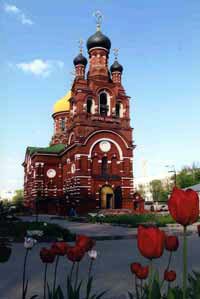
Among friends our parish Church is affectionately known as 'Red Village' because it is in the Krasnoselskaya district of Moscow. Krasny Selo, which can mean 'Red' or 'Beautiful' village (the word kransy has both meanings in Old Russian) was once an autonomous settlement that became a part of sprawling Moscow at some time in the late 19th or early 20th century. Our church is dedicated to 'All Saints' (Всех Святых) but the property was originally part of a large womens monastery that also had a large church dedicated to St. Alexis the Man of God (March 31 NS). Both churches are functioning again, but they are separated by a large road that now bisects what used to be the monastery property.

Posts with the Red Village label will be about day to day Orthodox life, some explanations of how we live and attitudes personal and general about life and dystopia.

Monday, March 17, 2008

Poor in Spirit

Monday, March 17 / 04, 2008 - Second Week of Great Lent
Translation of the relics of St. Wenceslaus + 938
St. Peter Michurin of Tobolsk +1820

I have always wondered about the 'poor in spirit' from the Beatitudes. My natural inclination has always been to regard this as referring to those who, for the sake of the Gospel, had managed to penetrate the spiritual realm and allow the strength of Christ to reign in them through a complete and overwhelming sense of mankind's spiritual poverty in this world. The upshot is that most of us are aware of our spiritual poverty only from a sense of duty and remain in a kind of weird denial, seeing our independence from God as a kind of wealth and freedom, etc. but hoping to get over this somehow. Of course we are Christians and we go to church and strive to make inroads in the spiritual life through prayer and striving for virtue, but this 'poverty in spirit' remains elusive. We can't help but view this kind of reliance on God as a kind of impractical extreme, like ditching our responsibilities and living as a homeless (mentally ill?) prophet on the street. It is not just that this is too difficult, however romantic, but that it's contrived and doesn't reflect the sobriety that is at the core of the peace of Christ.

Gotta be some middle ground in there somewhere.

On the other hand, plain old poverty - not the spiritual kind, but the impecunious lack of basic stuff and money kind of poverty - this kind of poverty is an old friend that visits pretty regularly. Scraping along to pay rent, tying wads of old nylons on the bathroom faucet to influence the course of various leaks and aggressive drips, wearing summer shoes all winter because they're the only pair I have. We are constantly putting off the replacement of one clunky household appliance in favor of tending to some other more immediate rent in the fabric of our daily existence. Riding the bus without paying because I can't afford a ticket seems to come more natural than it should.

Yet I can't consider myself 'poor'.

We regularly entreat St. Nicholas and St. Matrona and a half a dozen other favorite saints for work, for opportunities and for cash and it appears. We get by in this manner and have since I can remember. Everything in our life is a miracle of sorts. I don't mean the general miracle of 'isn't life just a hunky dory miracle' but the hard-line New Testament gold-coin-from-the-mouth of-a-fish-to-pay the man ala Peter kind of miracles. Fish and loaves stuff. The apartment we live in, narrow escapes from crippling bureaucratic blows, envelopes of cash handed my way in critical circumstance, job opportunities too numerous to even count and a seemingly endless stream of little things that have prevented eminent crises of the basic types that generally ruin your life - all this has come out of nowhere. Some would no doubt call this luck or coincidence. If so, then it has been a pretty comically excellent sting of luck. Truly, the regular poverty thing is much easier and, though less mysterious, has something to do with being poor in spirit.

Being a spiritual lame brain, I am usually forgetful of the source of my good fortune, my 'riches in poverty' as the line goes from the troparion to St. Nicholas. I tend to chalk it up my to being a snazzy knowledge worker-entrepreneur kind of guy with a sense of adventure. This suits my vanity most of the time when I am not seriously reflecting on the actual origin whatever it is I call my wealth and station in life. And then God will provide a momentary, sober glimpse into the mysterious 'poverty in spirit' thing. Just long enough to have a view of things really are in all their miraculous glory. It is amazing how simple it is to see in such brief, fleeting moments that everything is indeed from Him.

God could make us all blithering rich if He wanted, but instead He just lets us live as close to the edge as we are able so we can dip into the poverty of spirit every now and then, feeling the beautiful richness of our total dependence on Him.

The mysterious lock on this treasure chest is our inability to grasp and retain such moments as 'things'.

Saturday, March 8, 2008

On the Culture of Surveilance

(this post is an aside to an ongoing email exchange on a similar subject)


Given the current ubiquity of surveillance in our postmodern global society, the question thrust upon us would seem to be whether or not we are living in or on the threshold of George Orwell's 1984. Electronic monitoring for various intents and purposes has been propelled into deeper technology cycles by consumer demand as much as by government sponsorship, although we may never know the extent of the latter. The government may have bigger, badder and more expensive toys, but it is unclear if they have an actual edge or merely appear to have an edge and exploit this cognitive dissonance sandwich fashion on top of their monopoly on the use of force.

In any case, Orwellian psychology is facing stiff competition from our lemming like embrace of privacy effacing technology. Benthamite social pragmatism has also surfaced in a surreal fashion, with proponents ranging from the urban poor to the privileged elite. As the government spies on us with and without our consent in ever more pervasive and multifaceted ways, we are now spying on each other and grappling with the interpersonal, social and psychological issues of an ever more elusive definition of privacy and personal expression. It is no longer clearly 'us and them' but a more oblique Pogo-like 'they is us'.

It is increasingly difficult to live without technology or even in 'low-tech' environments. A friend suggested that real safeguards against techno-panoptic encroachment is none other than our own bureaucratic tendency. I think there is some merit in this point of view and it is one of the reasons I think Russia has more contra-Orwellian potential than other countries with more efficient bureaucracies. Also, given the tech savvy Russian population, the widespread availability of gadgets and the ubiquitous disregard for copyright, I think any 'Big Brother' advantage that the state might otherwise enjoy in the sphere of technology and surveillance in particular is more than matched by private individuals and neo-feudal entities like corporations, sub-cliques within private and public organizations and random geek clubs.

Indeed, in many ways the power gap is really narrowing between the state and individuals. It is difficult to say weather the increasingly Byzantine laws enacted around the globe in the name of security, privacy, anti-terrorism and 'safefy' are a play for greater control over various societies or a knee jerk reaction to the increasing power of individuals to obtain and distribute information for reasons that begin to mirror those that have previously been the prerogative of the state, including security, propaganda, the management of information and advantage in social, business and legal spheres. We often fail to see the desperate measures of the state as an effort to maintain sovereignty in a world where it is slipping away like the tide.

What is clear form this development is that while individuals face increasing pressure from state and commercial organizations that to influence their personal lives through IT infrastructure, individuals have at the same time more potential to influence their environment than ever before and face a range of decisions heretofore unimaginable in regard to the way they choose to participate in human society. The pressure of these choices is unavoidable and while the 'default' choice of choosing to ignore changes may result in the fulfillment of dystopian scenarios, the potential to throw rocks in the blender of any prepackaged political or social program sponsored by the state (or any organization for that matter) has becomes so great that new questions arise regarding the nature of freedom and its potential as well as the structure of a society in which the lines between coercion and cooperation become blurred by self interest.

Some things have not an are not likely to change. Human nature, being what it is, is likely to surprise in unexpected ways, both diabolical and heroic. In the given situation I think that it is important to remember that rational individuals, who have always been accountable to some degree for their own misery and happiness regardless of circumstances, are in no way relieved from the responsibility to make the right choices. One thing that dark Orwellian premonitions of human society propagate is the excuse that evil is unavoidable and that individuals compelled to live in surreal situations are less responsible for their actions because there is no choice without dire consequences. This may be true, but in the techno-dystopia where we are all potentially spies, terrorists, hackers and inside traders, unwitting or no, we no longer have 'Big Brother' to blame for our own capitulation to baser human instincts which were once barred from reality by the border between the imagination and reality but are now realizable with the click of a button. Morality and the daily choice between good and evil are no less a part life than before, but they are suddenly and unmistakably more public in their consequences.


Thursday, February 14, 2008

Futures

by Thomas

A tall, homely woman worked in an investment firm. She was socially awkward. A co-worker from another department, a fund manager who was not bad looking, thought he could get an easy date. He was too busy to court a real sexy woman, he told himself, the kind that require lots of money and buttering up. “This lady will be a cinch,” he said to himself with some pride in his shrewdness. He sat next to the homely woman in the company cafeteria.

"I was on the debating team in college," he said, not knowing what might impress the woman but unwilling to offer something better from his arsenal of wit and experience. He didn’t think it would take much more.


The woman, who had large eyes made even larger by coke bottle glasses, smiled uncomfortably but didn't ask the man to leave. She had been listening to him brag about his accomplishments for two weeks, saying almost nothing herself. He tried to get a reaction from her.

"So, what about you?" he said. "What can you do?" He felt he had her in his grip now, that soon she would do anything he wanted.

"I can do this," she said. She held out her hand, palm side up, made a clenched fist, and then opened her hand. There was a plastic fork in her hand.

"Er, wow. A fork.” The male co-worker was quite thrown by the fork. He had not planned on a miracle. “How did you do that?"

"I believe," she said, without any affectation. She used the fork to finish her lunch.

He was embarrassed. Reassessing his overtures in light of this new development, he saw that he was perhaps underbidding. He hoped to work the fork into his pitch.

"Can you show me how to do that?" he asked.

"Yes," she said. But after several tries and no success, the man became quite frustrated. He flipped his palm open aggressively several more times, until it got sore.

The woman stared and shrugged.

"What is faith?" he finally asked. She leaned over and whispered in his ear. He listened uncomprehendingly, trying to look agreeable. "Oh," he said, "you don't say?" He hoped he could fake it somehow, if not to get a date then to at least save face.

She looked at him blankly. He couldn’t tell if she saw he didn’t get it.

Suddenly her visage spun about in bright light. He stood back from the table and beheld the woman. Her solemn, bespectacled face shone a brilliant white, her figure that of a plain, but tender madonna. In a moment her dowdy sweater became radiant, her frizzy hair a flowing garment. In her chest, there was a golden fork twisting her heart. There was a little blood, but it looked so beautiful. There was music in the silence, a choir of voiceless cherubims.

In a flash, they were again in the lunchroom. The tall homely woman gave the man the plastic fork, smiled in a forced, toothy way and excused herself. She had to get back to work.

The co-worker decided to visit a financial consultant.

On the top of the building, in a large hall filled with swarming traders and computer screens, the floor littered with paper, an old man sat in a large fancy swivel chair in the center of activity. The man approached the chair from behind.

The financial consultant swiveled about, shafts of figures streaming upwards and across the screens mounted high about the vaulted room. The man had not spoken before the financial consultant inquired from his chair. "Do you love her?" he boomed, presaging his question. The man was doubly frightened to see that the financial consultant was blind.

"Yes," said the man, surprised at his own words. He meant to say that he hoped to get a date or something, but his calculation was thrown off in the presence of a higher fiscal authority.

"This stock is no good," said the financial consultant, his unseeing eyes rolling about slowly in his head in different directions. "Top heavy investment for unverifiable future returns – the fork market is saturated and there’ll be no one to bail you out - there is no turnaround potential with this one!"

The man considered the financial consultants words, but was still troubled. He had hoped to make a killing. "What if fork futures are undervalued?" he said to himself as he tapped away behind his computer.

On a whim, he went to visit a priest. He looked very familiar. He told him about the girl, his scheme and the fork.

"I want to join your religion," said the man.

"It’s expensive," said the old priest, who was also blind. "I will have to remove certain organs." There was a pause. Then the priest added, "Besides, how can you be sure that if you get religion that you will get the girl?"

"I believe," said the man, surprising himself.

"Ok," said the priest. And the man was initiated into the religion. The operation involved intangible elements, but was otherwise quick and painless. Afterwards, the priest wouldn't tell him what part of his body he had removed. The man felt lighter afterwards, though. He couldn't see anything missing. "It must be a mystery religion," he thought.

He went to work and everybody looked strange to him. Some were taller, others shorter. One man was now wearing a mask while another young man looked much older, his body wrapped in chains. His boss had flowers coming out of his head. He was quite disoriented, but no one seemed to notice. He had trouble getting into his chair and later in the bathroom he had to get a stool to see himself in the mirror. He discovered that he was a now a child. His clothes didn't fit him anymore. He looked for scars from the operation, but he could only see the same scars from the time before he got religion.

He approached the woman at lunchtime and she looked like a madonna all the time now, light streaming from her fingers as she typed at her cubicle. Like a schoolgirl she winked at him knowingly, as if to say "Shhhh! Don't tell anyone."

At lunch he forgot to ask the woman on a date. The feeling that he had forgotten something faded as the two talked about paper airplanes, their favorite movies and financial subjects indiscriminately intermixed. They giggled quietly, eating lunch with plastic forks that had come to them from another world.

"So," the man says, "you mean nobody can see us? We're invisible?"

"More or less," said the woman. "Do you like it?"

"Yes," said the man, who suddenly remembered what he had been trying to remember.

"Do I ever get to find out what was removed in the operation?"

"Sure," said the woman. She paused for a minute and then smiled wide. "Your eyes. You're blind now. I suppose that's why you don't know already."


Tuesday, February 12, 2008

Natives

by Thomas

A group of tourists was shipwrecked and reached safety on an uncharted island. The island was inhabited by savages who surrounded the worn and waterlogged group huddled on the beach and immediately announced that they intended to eat them all.

"You're inhuman!" cried one fat tourist with a Hawaiian shirt.

"It's our island fatso," said one savage with a necklace made of human finger bones.

"Yeah," said another savage, drooling a bit while eying the group, "when in Rome..."

The tourists were herded to a hotel where they were all given drinks and potato salad. Though alarmed, most were famished and dug in with gusto. The natives checked them in at spear point, noting body weight and other physical characteristics that might affect taste and cooking time. A native woman handed out moist towelettes to those waiting for the others to finish being checked in.

"Hey, everybody!" said the tour guide, an athletic type with a big chin, "can't you see they're just fattening us up for the slaughter?" There was general agreement, but nobody could think of a good alternative so they just milled about the hotel lobby, finishing their snacks.

Some of the tourists took rooms in the hotel while others moved into nearby bungalows. There was an orientation and a big dinner afterwards where tribal leaders introduced themselves and spoke about the local attractions and handed out chits for laundry service and urged the tourists not to smoke.

When the initial lounging subsided, there were plenty of activities to keep people busy. There were craft fairs and windsurfing classes. Many of tourists got involved in projects. A few whiners tried to escape, but the savages were in the bushes and drove most of them back with spears.

Folks settled in pretty well and met with other castaways who had arrived earlier and some who came later. At first there was plenty of talk about being eaten and what horrible people the natives were, but after a while most got involved in other things like yoga groups and volleyball teams. There was still speculation about the inevitable, but it was more like chit chat.

After many years, the naturalized inhabitants of the island began to die off. The natives were very attentive to the sick and feeble and provided extra comforts, easing the decent into old age.

"So, I thought you guys were going to eat everybody?" chuckled the once fat but now merely lumpy tourist as he was wheeled onto a sun porch for some fresh air outside the rest home where he now lived. He had become a champion cliff diver and scuba instructor with a gaggle of young ladies ever hanging on his arm.

"Oh, we'll eat you folks, alright," said the savage in charge of caring for him.

"Well, I used to be a meaty treat but now I am all blotchy skin and bones," he laughed more to himself than to his diligent but taciturn host-nurse. "Not much of a meal anymore. What are you savages waiting for anyway?" He thought the natives were all just a bunch of spineless twits.

The savage bared his teeth, his greasy war paint cracking on his small brown face and said, "You just wait."

The tourist guide, now a paunchy beach party patriarch, also mused on the irresolute threats of his savage 'captors'. "I have certainly past my prime beef stage." He had invented novel cocktails as a hobby and had written several plays. He even kept a few savages to wait on his personal needs.

Other tourists had also done whatever they wanted and had more or less excellent lives of creativity and self development in their captivity. As the constant threat of eventually being eaten never materialized, they grew indifferent and then abusive to the natives, making them the butt of scurrilous jokes and inconveniencing them with exorbitant, self indulgent requests.

A substantial group of survivors had escaped in the initial moments of their captivity and had hid themselves from the luxury of the native 'death camp'. They subsisted on putrid berries, brackish water and monomaniacal fear. They peered grimly though the bushes to observe the secret burial ritual the savages reserved for their prisoners who passed away.

The savages interred the bodies on large dishes amidst piles of the islands most beautiful and exotic fruits and flowers. They danced a solemn dance and sang the praises of their victorious warrior gods who received the prizes of furious hope and patient self denial.

Sunday, February 10, 2008

On Achievement

I recently got the thrill of learning that one of my original recipes has found its way onto the menu of a well to do private restaurant in the Moscow city center. The venue is a high end food service amenity inside a class 'A' office complex, the Ducat III Office Center. To be fair, I know the chef and he shares his secrets with me. I never figured, however, that the flow of recipes would go in the other direction. I receive no royalties for this apparent infringement of copyright, but this is because I enjoy the privileges of having access to my chief friend's purchasing tentacles, which stretch far beyond the average Muscovite supermarket.

I know enough about the world of cheffing to know that getting a little creativity rush in this way is a great alternative to actually becoming a chef and breaking my rear to garner such a compliment.

The dish is a salad. I call it Mediterranean Couscous with Cordova Glazed Shrimp and it rocks at parties as well as intimate meals for two. It is basically Mediterranean fusion and can be a side dish or a main dish depending on the presentation.

My chef friend said his executive clients eat it up and he makes a killing at the cash register.

And so I bask in microtriumph.

Friday, October 26, 2007

Bums

By Thomas

Some bums were gathered under a bridge drinking cheap wine straight from the bottle. They smelled really bad and looked shabby from sleeping in their clothes.

“And this globalism business, its nothing but the logical result of secular humanism,” a lanky bum says, taking a swig from the bottle.

“Ya gotta admit its pretty shallow foundation, despite the magnitude of its ramifications,” says another, “but the alternative guys are only offering backward thinking socialism.” He burps.

A third guy, his eyes going in different directions, suggests rethinking collectivism in a different, non-Marxist paradigm. A black guy without shoes smoking a short, wet cigarette he has found on the ground reminds them all that capitalism has made such inroads into the human psyche that any alternative would be reactionary by definition.

“Wish brins me beck ta my ’riginal point,” the lanky bum says, “and daas…”

“Excuse me,” says a cologned voice apart from the group. It’s two well groomed business executives in crisp suits with leather briefcases. “Could you gentlemen help a man out?” Both the speaker and his friend have got their eyes fastened not on the bums, but on the bottle. “You see, its my birthday and, uhm, I’m new in town and my friends mother is in the hospital and we won’t bother you any more if you’d just help us out a little, you know, just tiny a swig from that bottle or something…”

The bums get a tad uncomfortable and look away. “As I was sayin’,” says the lanky bum, trying to focus on his friends and screen out the men in suits. Their cologne wafted in their midst and overpowered everybody’s thinking.

“Aw, gowan. Give these guys a hit from the bottle,” a short bum in a greasy baseball cap says. “F’godsake doncha have a heart?”

They give the clean shaven executives a hit, which they take greedily, each downing a good deal more than a swig. The businessman who spoke hands the bottle back and says thanks and the two hurry off to a corner where they clumsily apply more cologne and get into a waiting BMW.

“It isn’t right to give them a drink,” says the lanky bum, wiping off the bottle opening with a cleaner part of his untucked shirt.

“Yeah, but if you don’t he’ll never do it for himself. That guy probably spends a fortune on organic carrots and vitamins,” says the short bum, finishing his sentence. “Why not let threm live it up once? What kinda life do these guys have? What do they got to look forward too for the rest of the day?”

“Still, it only encourages them to beg more,” says a fourth bum, who has been peeing on the concrete a few yards away. He doesn’t bother to zip up as he returns to the group. “You’re keeping those guys locked in a dizzy cycle of prosperity that’s gonna kill them someday. I don’t know what you people are thinking, really…”

“I feel sorry for the, and all,” says the black guy, “and I know they come from bad families and stuff, but I think they gotta live with the choices they make, you know, like the rest of us. Everybody’s responsible for themselves and no amount of charity is gonna get those guys back on his feet again. They’ve gotta do something themselves for their own good.”

A breeze from the freeway towering above the bums blows the scent of cologne away into a clear sky. In the early morning sun, they watch the BMW zip away up onto the bridge and onto the freeway.

“Hey,” says the lanky bum, “I don’t care about those rich guys at all. Let ‘em eat each other and die from stress. They deserve it. Let’s face it – some people just can’t handle freedom.”

There was a murmur of general agreement. They pass another bottle around in the businessman’s honor, each bum taking a long draught for the doubtful future of the morning’s guests.

Monday, October 22, 2007

On Weird Drinks

One of the the really fun things about a different culture is the weird stuff they eat and drink and call 'normal'. Of course, its normal, but for you it is strange. Russia is a great country for confronting a person with strange things to drink. In the popular imagination, of course, Russians only drink vodka and tea and, perhaps assuming convention, Coca Cola. The fact is, Russians drink some really odd stuff, not all of which has found conformable footing with your man on the scene.

Kvass. This was the first weird drink I encountered in Russia and remains one of my favorites.
Kvass is a cross between bread soda and beer. It is made from dark brown bread, which gives it its color and yeasty beery good taste, and a few raisins, which help give it sweet fizz. I first had kvass in the summer of 1994. A friend bought me a cup from a lady who was pouring it out of a tap from a big yellow vat on wheels on the street, a kvass-truck. I was an instant fan. Originally, kvass was a seasonal drink. Unless you made it yourself (which I discovered most people did) you had to wait for the summer kvass trucks to start popping up around the metro stations in Moscow to get yourself a frothy cup of cool sweetness. Around 2001, local drink makers started producing 1 liter bottles of the stuff, which were invariably off and gag inducing. One commercial outfit, a McDonald's copy cat fast food place called Russky Bistro, produced a great bottled variant which was so popular they we almost always out of it. We tried the various kits and some were better than others, but none compared to the homemade stuff from the hands of an experienced grannie. It seems that the simple combination of a half a loaf of black bread and a few raisins is quite a temperamental combination and getting it right requires practice and patience. Good kvass is only good for a certain period after which it either goes flat or sours, much in the way an open beer doesn't stay inviting for a long time. Bottled variants have only controlled this natural window of tastiness by adding other stuff which keeps the fizz and stabilizes the sweetness, but at the same time turns the drink into an over carbonated, syrupy cola like drink that is truly weird and barfy. Many restaurants, however, made their own and have pretty good consistency. My advice - unless you are in the company of the family that made it or are at a recommended restaurant where it is on the menu, its best to try kvass in the summer when the pros get down to business.

Medovukha I first had this weird drink in Suzdal and I remember being so thirsty I would drink anything. My wife recommended against it - she said it was alcoholic and didn't quench one's thirst. I bought a homemade half liter and tired it in desperation and I found that it not only quenched my thirst, but was hardly alcoholic. Medovukha is basically honey mead, a sweet often fruity fermented drink that does contain alcohol, sometimes more and sometime
s less. The homemade stuff I had was probably in the .5% alcohol range, but it gets right up there to about 5% - 7%. Like kvass, it is mostly homemade stuff and the range of taste varies depending on the maker. Suzdal is a touristy place along the Golden Ring route of towns and settlements with their beautiful churches and artsy craftsy people making their living off the crowd in period costumes hawking hand carved spoons and dolls, paintings and icons. And medovukha. Once a staple of Russian life, medovukha faded in the wake of mass produced vodka, but is making a comeback today. Bottled variants containing higher alcohol content are available from different brands in different flavors, including berry and fruit. I mush prefer the homemade, low alcohol stuff, but the commercial stuff is an interesting side journey for the adventurous.

Chifir The rage in all Moscow cafes these days is the dubious South American drink mate, the origins of which are a bit obscure to me. The wholesale importation of this over rated, fetid drink is seemingly without cause - there is no cultural link to South America that would easily explain this, say, in the way that we can explain the presence of so many hookahs in these very same cafes. Russia has direct links to the East and the hookah, called a kalyan here, is popular among 'Southern' people. It has become fashionable among Muscovites who want to spend 600 - 1000 rubles and an hour to smoke dried fruit. Chifir, however popular, does not have such a high profile. As is well known, chifir is
a prison drink. This is to say that it was born of necessity behind bars and spread among the population at large through those who brought it with them to the outside. The origin of the word may have additional meanings in the complex underground language of Russian prison cant, but on the surface it is a combinations of the words 'tea' (chai) + kefir. (check the picture to the right to observe prisoner making chifir) Basically, chifir is a super concentrated batch of tea capable of getting the drinker off on a serious caffeine high. The original recipe is a spoonful of sugar, 3 to 5 (usually much more) packets of tea (spoonfuls of loose tea) and 1 to 1-1/2 cups of water or 3/4 to 1 cup of milk. This mixture is boiled for 10 - 15 minutes, reduced and drained to produce a disgusting base of about half the original volume for the real drink. Next, more sugar and about a cup of milk is added and again brought to a boil before serving. Supposedly the correct boiling times and proper administration of milk and sugar will turn this rank caffeine soup into a creamy, pleasant drink, but don't put your money on it. I had my first taste of a more common but less complicated cross between mate and chifir in a monastery where the visiting pilgrims had little in the way of tea paraphernalia save the tea itself. Without much ado, one ex-army guy jerry rigged a heating device by connecting two loose wires found in a closet to a razor blade. This was subsequently propped in a 1.5 liter mason jar full of water and the other ends inserted directly into a 220 volt outlet in the wall. I was told that this death contraption was commonplace and that since engineers were common among groups of Russian friends, it was very unlikely anyone would get hurt if they were not stupendously drunk (a caveat indeed). The water raged to a boil very quickly, the device was removed and a whole box of tea was dumped into the jar. The dearth of cups posed no problem - there was a pair of oven mitts handy and we shared them as we took turns sipping intoxicatingly strong tea directly from the jar, prison style. Sugar only made it disgustingly sweet. If we would have had milk, I'm sure it would have been disgustingly sweet and creamy. I have also tried the mate thing and I can say that for all the winebibber like talk about aromas and hints of tobacco and cherry, an sufficiently large amount of ordinary commercially available black tea will produce a taste not substantially different than what the fru-fru types pay mucho dinero for at a premium in cafes.

Tarkhun and Baikal The Soviets, not to lag behind the Americans in anything, beg
an producing their own brands of carbonated soft drinks, collectively called 'limoade', in the early 1970's. Lacking the secrets of Coke's magical ingredient 'x' did not pose a problem to a country with tastes significantly further off the scale than those of their cold war rival. Tarkhun flavored pop, bright green and based on the herb estragon (tarragon), has been popular since its inception. Even more popular is a dark colored Baikal, a drink based on eucalyptus, laurel leaves and St. John's Wort. It is named after the famous lake where the grass and herbs used to produce it supposedly originate. Takhun will make anyone sick, as far as I know, but Baikal is a treasure and I do my share to keep the national consumption statistics floating high. Other popular flavors include pear, golden nut (alternative to cola made primarily with hazel nut) and a 7-up like drink called 'Belfry'. The weirdest flavor of them all has to be 'Buratino,' the Russian name for the still very popular fairly tale character that we know as Pinocchio. The actual flavor of this drink is quite debatable, somewhere between cream soda and yellow #5. I think it is primarily a marketing thing and whatever goes into the bottle is of secondary consideration to the marketers.

Compote Actually a universal drink and not even that weird, compote has serious staying power here in Russia. The surprising thing is that there are no commercial varieties available, despite being ubiquitous in restaurants and cafes. Like in many Russian homes, we make our own. I often buy a blend of mixed dried fruit and this is one of my
favorites, but my wife and the kids are stuck on cherry compote. Fruit and water with a bit of sugar. Nothing could be simpler and you get to have a big say in how sweet or sour it is. I remember my grandmother talking about compote when I was a child but nobody ever made it so I always thought it was a prohibition era thing. It is a great way to stretch your ruble a little further and give 'em all what they really want. I have made smoked pear compote (oh my!) and apricot compote and Sonia makes several varieties of apple compote ranging from the lightest, coolest flavor to a punchy, pulpy kind that the kids like.

Beryozovy Sok This is simply birch tree sap. When I first came to Russia, it was available in the huge 3 liter jars which have sadly gone out of style. A clear, light liquid, beryozovy sok (lit. birch juice) is made from sap collected at a specific period during the summer. The taste is acquired and is frankly like - well, tree flavor. On a hot summer day or better, in the
pred-bannik of the Russian banya (sauna) it is one of the most refreshing drinks you can imagine. It is not terribly sweet, nor pungent but somehow lighter, if possible, than water itself. The taste is subtle, but distinctly woody. If you didn't know what it was, you might be able to guess just from tasting it. It is used in making other drinks and tonics such as birch beer and Nordic stuff like wintergreen flavored candy. It has mild medicinal (homeopathic) qualities. It has been harder to find commercially, but the real thing is certainly available in smaller towns and villages where they keep the tradition alive by simply not having any alternatives. Bottled variants imported from Belorussia or Georgia are available in Moscow but are mostly sugary counterfeits.

Kissel Texture is one of those very sensitive things that you can never get around but take for granted at the same time. The most unappealing, weird thing about kissel (accent on the last vowel) is that it is a thick, viscous drink. Kissel is usually fruit flavored, cherry, grape and berry being the popular flavors, that is thickened with, of all things, cornstarch. Or in the case of Russia, potato starch. When cooled, kissel develops a 'skin' that is doubly off putting for many. It was years before I could drink it, but I have been completely domesticated now and drink it quite regularly. A room temperature, kissel is a great thirst quencher and quite tasty once one gets used to its milder taste. Kissel is typically available in Russian cafeterias and easily made at home from cheap powdered mixes. It is excellent for an upset stomach and IBS (irritable bowl syndrome - wink wink nudge nudge say no more).

Zbiten. This is a hot, honey based drink with a long history in Russia. Zbiten (or Sbiten) is made in various ways, mostly with spices and approximates a mead-glint wine type drink. In some cases it is alcoholic, but mostly it is not. It is a winter drink, sweet and invigorating with Christmassy spices like cinnamon and star anise. Think of skiing or outdoor activity in the heavy Russian winter and Zbiten is right there where coco might be for Americans. Typical versions I have tried were heavy on cinnamon and ginger. 'Teremok,' a local fast food chain selling blini and kasha, has revived the drink in popular culture. Bottled versions tend to be inferior (and cold) and like kvass, do not do as well as the fresh brewed, homemade versions. I have recently been to the 'House of Honey' here in Moscow and purchased a commercially available zbiten concentrate which is pretty good. I am currently working on my own recipe now that I have a line on the best Siberian white honey.

Bizarre dairy products. Almost all Russians drink kefir, a cultured milk beverage not unknown in the US, where it was introduced by Russian jews. Here is a staple available in 1%, 2.5% and 3.2% varieties and remains more popular than the now pervasive liquid yogurts like Actimel and Dannon. It is better for you than yogurt and functions to filter a lot of nasty stuff out of your system as well as to restore micro-organisms in the digestive tract. I drink kefir regularly. It is satisfyingly thicker than milk but not lumpy like yogurt. The bacteria culture gives it a slight 'bite' to it that I really like. Competition for your kefir ruble is very intense in Russian supermarkets and there are at least 20 brands crowding each other off the shelf. A spin on kefir is 'bio' or 'bifidophilus' kefir, sometimes called 'bifidok' which is rather redundant as it is made by adding the same enzyme culture plus bifidus culture. Other unusual dairy drinks include snezhok, a sweetened form of light kefir (the name means 'snowflake') , prostakvashina and ryazhinka. The usual claim is that the latter two are 'buttermilk-like' drinks, but this is utter nonsense. Prostakvashina is nothing other than sour (read: off) milk and ryazhenka is boiled milk. The former is good for making traditional Russian pancakes (blini) but too disgusting to drink, although it is quite popular among children (go figure). I have have never aquired a taste for either drink, but I do like a snezhok every now and then. The granddaddy of all weird dairy drinks, however, is kumis - a heavy, slightly alcoholic form of kefir made from mare's milk. That's right. Horse milk. This is not as common as the others, being more of a central Asian thing, but it can be found here. The smell...

There are other unusual alcoholic drinks, but these should be treated in a separate post about booze or something as they are not your everyday drinks like those listed here.