Wednesday, July 16, 2008

My Live Journal Sign Up Thing

The world is complicated enough, I think, without some techno-genius trying to make things simpler by developing software protocols so that when a guy wants to comment on a Live Journal page, he has to create a saga-profile and create his own page. I simply want to comment on the entries of others, I do not want my own page, thank you. Are all on line communities this evangelical in their structure?

Anyway, I was looking for a long lost friend and a series of searches brought me to this Live Journal page (where the person I was looking for was not) but as it was moderated by a group of St. Hermanites / Platinaens I hung out and caught up on the histories of some displaced persons. It was kind of neat. I buckled to the hassleaneous prerequisites and spend what seemed like an hour in ergonomic dystopia, hunting and pecking for buttons that would get me results. In the end, I had signed up, stated preferences, given a list of hobbies, books and pets and I had to provide an introduction as a means of gaining commentary access to the sthermanorphans live journal page. Here it is.

About Yourself:

"I was really looking for someone / something else, but I found this Live Journal thing with St. Herms people. I never could have imagined such a thing. Me? I visited back in 2006 for a few days - the first time in over 10 years. I dream of going more often, but I don't live in the US. I am trying to be a productive Stray Sheep. I do not consider myself a STHB orphan, I just woke up one day in another country.

Imagine the prodigal son's brother (the bitter goodie two shoes) going away to prove to his father that he is A MAN and when he comes home, beaten and deformed but holding a few scales of the dragon, he discovers that the family farm has burned down and his father and brother have set up shop with the dragon, who is now a full partner. In time the bitterness passes and is replaced variously with despair, anger, irony and finally a sense of self and purpose outside the farm thing. The brother begins to see he isn't who he thought he was after all - that he was indeed a man all along but very far from being a goodie two shoes. This was rather predictable and caused self doubt. Resolving to start over as a 'baddie three shoes' or a lame superhero who never could fly, was never impervious to bullets, fire or even nasty comments, the brother gets down to the business that was his original purpose at the farm in the first place - obtaining self knowledge. Its tough without the family, but ultimately more productive as the brother is kind of a loner.

The greatest day of his life was not the long awaited pat on the head from dad but the sideways look from the prodigal brother who said simply, "Yes, what is it? Can't you see we're busy?" He has always liked his party-hearty but repentant brother, but remains jealous in fear that dad gives him all the attention. Hense the escape thing. He is sometimes lonely, but true to himself and God, now understanding that he never wanted to be a groupie anyway. He has found happiness and writes home every now and then. He has made peace with the dragon. He is nothing special. He just grew up to be a broken man all on his own, without the help of STHB.

He quietly hopes they will all come to visit someday."

So there.

Wednesday, March 26, 2008

Red Village


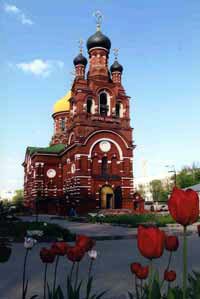
Among friends our parish Church is affectionately known as 'Red Village' because it is in the Krasnoselskaya district of Moscow. Krasny Selo, which can mean 'Red' or 'Beautiful' village (the word kransy has both meanings in Old Russian) was once an autonomous settlement that became a part of sprawling Moscow at some time in the late 19th or early 20th century. Our church is dedicated to 'All Saints' (Всех Святых) but the property was originally part of a large womens monastery that also had a large church dedicated to St. Alexis the Man of God (March 31 NS). Both churches are functioning again, but they are separated by a large road that now bisects what used to be the monastery property.

Posts with the Red Village label will be about day to day Orthodox life, some explanations of how we live and attitudes personal and general about life and dystopia.

Monday, March 17, 2008

Poor in Spirit

Monday, March 17 / 04, 2008 - Second Week of Great Lent
Translation of the relics of St. Wenceslaus + 938
St. Peter Michurin of Tobolsk +1820

I have always wondered about the 'poor in spirit' from the Beatitudes. My natural inclination has always been to regard this as referring to those who, for the sake of the Gospel, had managed to penetrate the spiritual realm and allow the strength of Christ to reign in them through a complete and overwhelming sense of mankind's spiritual poverty in this world. The upshot is that most of us are aware of our spiritual poverty only from a sense of duty and remain in a kind of weird denial, seeing our independence from God as a kind of wealth and freedom, etc. but hoping to get over this somehow. Of course we are Christians and we go to church and strive to make inroads in the spiritual life through prayer and striving for virtue, but this 'poverty in spirit' remains elusive. We can't help but view this kind of reliance on God as a kind of impractical extreme, like ditching our responsibilities and living as a homeless (mentally ill?) prophet on the street. It is not just that this is too difficult, however romantic, but that it's contrived and doesn't reflect the sobriety that is at the core of the peace of Christ.

Gotta be some middle ground in there somewhere.

On the other hand, plain old poverty - not the spiritual kind, but the impecunious lack of basic stuff and money kind of poverty - this kind of poverty is an old friend that visits pretty regularly. Scraping along to pay rent, tying wads of old nylons on the bathroom faucet to influence the course of various leaks and aggressive drips, wearing summer shoes all winter because they're the only pair I have. We are constantly putting off the replacement of one clunky household appliance in favor of tending to some other more immediate rent in the fabric of our daily existence. Riding the bus without paying because I can't afford a ticket seems to come more natural than it should.

Yet I can't consider myself 'poor'.

We regularly entreat St. Nicholas and St. Matrona and a half a dozen other favorite saints for work, for opportunities and for cash and it appears. We get by in this manner and have since I can remember. Everything in our life is a miracle of sorts. I don't mean the general miracle of 'isn't life just a hunky dory miracle' but the hard-line New Testament gold-coin-from-the-mouth of-a-fish-to-pay the man ala Peter kind of miracles. Fish and loaves stuff. The apartment we live in, narrow escapes from crippling bureaucratic blows, envelopes of cash handed my way in critical circumstance, job opportunities too numerous to even count and a seemingly endless stream of little things that have prevented eminent crises of the basic types that generally ruin your life - all this has come out of nowhere. Some would no doubt call this luck or coincidence. If so, then it has been a pretty comically excellent sting of luck. Truly, the regular poverty thing is much easier and, though less mysterious, has something to do with being poor in spirit.

Being a spiritual lame brain, I am usually forgetful of the source of my good fortune, my 'riches in poverty' as the line goes from the troparion to St. Nicholas. I tend to chalk it up my to being a snazzy knowledge worker-entrepreneur kind of guy with a sense of adventure. This suits my vanity most of the time when I am not seriously reflecting on the actual origin whatever it is I call my wealth and station in life. And then God will provide a momentary, sober glimpse into the mysterious 'poverty in spirit' thing. Just long enough to have a view of things really are in all their miraculous glory. It is amazing how simple it is to see in such brief, fleeting moments that everything is indeed from Him.

God could make us all blithering rich if He wanted, but instead He just lets us live as close to the edge as we are able so we can dip into the poverty of spirit every now and then, feeling the beautiful richness of our total dependence on Him.

The mysterious lock on this treasure chest is our inability to grasp and retain such moments as 'things'.

Saturday, March 8, 2008

On the Culture of Surveilance

(this post is an aside to an ongoing email exchange on a similar subject)


Given the current ubiquity of surveillance in our postmodern global society, the question thrust upon us would seem to be whether or not we are living in or on the threshold of George Orwell's 1984. Electronic monitoring for various intents and purposes has been propelled into deeper technology cycles by consumer demand as much as by government sponsorship, although we may never know the extent of the latter. The government may have bigger, badder and more expensive toys, but it is unclear if they have an actual edge or merely appear to have an edge and exploit this cognitive dissonance sandwich fashion on top of their monopoly on the use of force.

In any case, Orwellian psychology is facing stiff competition from our lemming like embrace of privacy effacing technology. Benthamite social pragmatism has also surfaced in a surreal fashion, with proponents ranging from the urban poor to the privileged elite. As the government spies on us with and without our consent in ever more pervasive and multifaceted ways, we are now spying on each other and grappling with the interpersonal, social and psychological issues of an ever more elusive definition of privacy and personal expression. It is no longer clearly 'us and them' but a more oblique Pogo-like 'they is us'.

It is increasingly difficult to live without technology or even in 'low-tech' environments. A friend suggested that real safeguards against techno-panoptic encroachment is none other than our own bureaucratic tendency. I think there is some merit in this point of view and it is one of the reasons I think Russia has more contra-Orwellian potential than other countries with more efficient bureaucracies. Also, given the tech savvy Russian population, the widespread availability of gadgets and the ubiquitous disregard for copyright, I think any 'Big Brother' advantage that the state might otherwise enjoy in the sphere of technology and surveillance in particular is more than matched by private individuals and neo-feudal entities like corporations, sub-cliques within private and public organizations and random geek clubs.

Indeed, in many ways the power gap is really narrowing between the state and individuals. It is difficult to say weather the increasingly Byzantine laws enacted around the globe in the name of security, privacy, anti-terrorism and 'safefy' are a play for greater control over various societies or a knee jerk reaction to the increasing power of individuals to obtain and distribute information for reasons that begin to mirror those that have previously been the prerogative of the state, including security, propaganda, the management of information and advantage in social, business and legal spheres. We often fail to see the desperate measures of the state as an effort to maintain sovereignty in a world where it is slipping away like the tide.

What is clear form this development is that while individuals face increasing pressure from state and commercial organizations that to influence their personal lives through IT infrastructure, individuals have at the same time more potential to influence their environment than ever before and face a range of decisions heretofore unimaginable in regard to the way they choose to participate in human society. The pressure of these choices is unavoidable and while the 'default' choice of choosing to ignore changes may result in the fulfillment of dystopian scenarios, the potential to throw rocks in the blender of any prepackaged political or social program sponsored by the state (or any organization for that matter) has becomes so great that new questions arise regarding the nature of freedom and its potential as well as the structure of a society in which the lines between coercion and cooperation become blurred by self interest.

Some things have not an are not likely to change. Human nature, being what it is, is likely to surprise in unexpected ways, both diabolical and heroic. In the given situation I think that it is important to remember that rational individuals, who have always been accountable to some degree for their own misery and happiness regardless of circumstances, are in no way relieved from the responsibility to make the right choices. One thing that dark Orwellian premonitions of human society propagate is the excuse that evil is unavoidable and that individuals compelled to live in surreal situations are less responsible for their actions because there is no choice without dire consequences. This may be true, but in the techno-dystopia where we are all potentially spies, terrorists, hackers and inside traders, unwitting or no, we no longer have 'Big Brother' to blame for our own capitulation to baser human instincts which were once barred from reality by the border between the imagination and reality but are now realizable with the click of a button. Morality and the daily choice between good and evil are no less a part life than before, but they are suddenly and unmistakably more public in their consequences.


Thursday, February 14, 2008

Futures

by Thomas

A tall, homely woman worked in an investment firm. She was socially awkward. A co-worker from another department, a fund manager who was not bad looking, thought he could get an easy date. He was too busy to court a real sexy woman, he told himself, the kind that require lots of money and buttering up. “This lady will be a cinch,” he said to himself with some pride in his shrewdness. He sat next to the homely woman in the company cafeteria.

"I was on the debating team in college," he said, not knowing what might impress the woman but unwilling to offer something better from his arsenal of wit and experience. He didn’t think it would take much more.


The woman, who had large eyes made even larger by coke bottle glasses, smiled uncomfortably but didn't ask the man to leave. She had been listening to him brag about his accomplishments for two weeks, saying almost nothing herself. He tried to get a reaction from her.

"So, what about you?" he said. "What can you do?" He felt he had her in his grip now, that soon she would do anything he wanted.

"I can do this," she said. She held out her hand, palm side up, made a clenched fist, and then opened her hand. There was a plastic fork in her hand.

"Er, wow. A fork.” The male co-worker was quite thrown by the fork. He had not planned on a miracle. “How did you do that?"

"I believe," she said, without any affectation. She used the fork to finish her lunch.

He was embarrassed. Reassessing his overtures in light of this new development, he saw that he was perhaps underbidding. He hoped to work the fork into his pitch.

"Can you show me how to do that?" he asked.

"Yes," she said. But after several tries and no success, the man became quite frustrated. He flipped his palm open aggressively several more times, until it got sore.

The woman stared and shrugged.

"What is faith?" he finally asked. She leaned over and whispered in his ear. He listened uncomprehendingly, trying to look agreeable. "Oh," he said, "you don't say?" He hoped he could fake it somehow, if not to get a date then to at least save face.

She looked at him blankly. He couldn’t tell if she saw he didn’t get it.

Suddenly her visage spun about in bright light. He stood back from the table and beheld the woman. Her solemn, bespectacled face shone a brilliant white, her figure that of a plain, but tender madonna. In a moment her dowdy sweater became radiant, her frizzy hair a flowing garment. In her chest, there was a golden fork twisting her heart. There was a little blood, but it looked so beautiful. There was music in the silence, a choir of voiceless cherubims.

In a flash, they were again in the lunchroom. The tall homely woman gave the man the plastic fork, smiled in a forced, toothy way and excused herself. She had to get back to work.

The co-worker decided to visit a financial consultant.

On the top of the building, in a large hall filled with swarming traders and computer screens, the floor littered with paper, an old man sat in a large fancy swivel chair in the center of activity. The man approached the chair from behind.

The financial consultant swiveled about, shafts of figures streaming upwards and across the screens mounted high about the vaulted room. The man had not spoken before the financial consultant inquired from his chair. "Do you love her?" he boomed, presaging his question. The man was doubly frightened to see that the financial consultant was blind.

"Yes," said the man, surprised at his own words. He meant to say that he hoped to get a date or something, but his calculation was thrown off in the presence of a higher fiscal authority.

"This stock is no good," said the financial consultant, his unseeing eyes rolling about slowly in his head in different directions. "Top heavy investment for unverifiable future returns – the fork market is saturated and there’ll be no one to bail you out - there is no turnaround potential with this one!"

The man considered the financial consultants words, but was still troubled. He had hoped to make a killing. "What if fork futures are undervalued?" he said to himself as he tapped away behind his computer.

On a whim, he went to visit a priest. He looked very familiar. He told him about the girl, his scheme and the fork.

"I want to join your religion," said the man.

"It’s expensive," said the old priest, who was also blind. "I will have to remove certain organs." There was a pause. Then the priest added, "Besides, how can you be sure that if you get religion that you will get the girl?"

"I believe," said the man, surprising himself.

"Ok," said the priest. And the man was initiated into the religion. The operation involved intangible elements, but was otherwise quick and painless. Afterwards, the priest wouldn't tell him what part of his body he had removed. The man felt lighter afterwards, though. He couldn't see anything missing. "It must be a mystery religion," he thought.

He went to work and everybody looked strange to him. Some were taller, others shorter. One man was now wearing a mask while another young man looked much older, his body wrapped in chains. His boss had flowers coming out of his head. He was quite disoriented, but no one seemed to notice. He had trouble getting into his chair and later in the bathroom he had to get a stool to see himself in the mirror. He discovered that he was a now a child. His clothes didn't fit him anymore. He looked for scars from the operation, but he could only see the same scars from the time before he got religion.

He approached the woman at lunchtime and she looked like a madonna all the time now, light streaming from her fingers as she typed at her cubicle. Like a schoolgirl she winked at him knowingly, as if to say "Shhhh! Don't tell anyone."

At lunch he forgot to ask the woman on a date. The feeling that he had forgotten something faded as the two talked about paper airplanes, their favorite movies and financial subjects indiscriminately intermixed. They giggled quietly, eating lunch with plastic forks that had come to them from another world.

"So," the man says, "you mean nobody can see us? We're invisible?"

"More or less," said the woman. "Do you like it?"

"Yes," said the man, who suddenly remembered what he had been trying to remember.

"Do I ever get to find out what was removed in the operation?"

"Sure," said the woman. She paused for a minute and then smiled wide. "Your eyes. You're blind now. I suppose that's why you don't know already."


Tuesday, February 12, 2008

Natives

by Thomas

A group of tourists was shipwrecked and reached safety on an uncharted island. The island was inhabited by savages who surrounded the worn and waterlogged group huddled on the beach and immediately announced that they intended to eat them all.

"You're inhuman!" cried one fat tourist with a Hawaiian shirt.

"It's our island fatso," said one savage with a necklace made of human finger bones.

"Yeah," said another savage, drooling a bit while eying the group, "when in Rome..."

The tourists were herded to a hotel where they were all given drinks and potato salad. Though alarmed, most were famished and dug in with gusto. The natives checked them in at spear point, noting body weight and other physical characteristics that might affect taste and cooking time. A native woman handed out moist towelettes to those waiting for the others to finish being checked in.

"Hey, everybody!" said the tour guide, an athletic type with a big chin, "can't you see they're just fattening us up for the slaughter?" There was general agreement, but nobody could think of a good alternative so they just milled about the hotel lobby, finishing their snacks.

Some of the tourists took rooms in the hotel while others moved into nearby bungalows. There was an orientation and a big dinner afterwards where tribal leaders introduced themselves and spoke about the local attractions and handed out chits for laundry service and urged the tourists not to smoke.

When the initial lounging subsided, there were plenty of activities to keep people busy. There were craft fairs and windsurfing classes. Many of tourists got involved in projects. A few whiners tried to escape, but the savages were in the bushes and drove most of them back with spears.

Folks settled in pretty well and met with other castaways who had arrived earlier and some who came later. At first there was plenty of talk about being eaten and what horrible people the natives were, but after a while most got involved in other things like yoga groups and volleyball teams. There was still speculation about the inevitable, but it was more like chit chat.

After many years, the naturalized inhabitants of the island began to die off. The natives were very attentive to the sick and feeble and provided extra comforts, easing the decent into old age.

"So, I thought you guys were going to eat everybody?" chuckled the once fat but now merely lumpy tourist as he was wheeled onto a sun porch for some fresh air outside the rest home where he now lived. He had become a champion cliff diver and scuba instructor with a gaggle of young ladies ever hanging on his arm.

"Oh, we'll eat you folks, alright," said the savage in charge of caring for him.

"Well, I used to be a meaty treat but now I am all blotchy skin and bones," he laughed more to himself than to his diligent but taciturn host-nurse. "Not much of a meal anymore. What are you savages waiting for anyway?" He thought the natives were all just a bunch of spineless twits.

The savage bared his teeth, his greasy war paint cracking on his small brown face and said, "You just wait."

The tourist guide, now a paunchy beach party patriarch, also mused on the irresolute threats of his savage 'captors'. "I have certainly past my prime beef stage." He had invented novel cocktails as a hobby and had written several plays. He even kept a few savages to wait on his personal needs.

Other tourists had also done whatever they wanted and had more or less excellent lives of creativity and self development in their captivity. As the constant threat of eventually being eaten never materialized, they grew indifferent and then abusive to the natives, making them the butt of scurrilous jokes and inconveniencing them with exorbitant, self indulgent requests.

A substantial group of survivors had escaped in the initial moments of their captivity and had hid themselves from the luxury of the native 'death camp'. They subsisted on putrid berries, brackish water and monomaniacal fear. They peered grimly though the bushes to observe the secret burial ritual the savages reserved for their prisoners who passed away.

The savages interred the bodies on large dishes amidst piles of the islands most beautiful and exotic fruits and flowers. They danced a solemn dance and sang the praises of their victorious warrior gods who received the prizes of furious hope and patient self denial.

Sunday, February 10, 2008

On Achievement

I recently got the thrill of learning that one of my original recipes has found its way onto the menu of a well to do private restaurant in the Moscow city center. The venue is a high end food service amenity inside a class 'A' office complex, the Ducat III Office Center. To be fair, I know the chef and he shares his secrets with me. I never figured, however, that the flow of recipes would go in the other direction. I receive no royalties for this apparent infringement of copyright, but this is because I enjoy the privileges of having access to my chief friend's purchasing tentacles, which stretch far beyond the average Muscovite supermarket.

I know enough about the world of cheffing to know that getting a little creativity rush in this way is a great alternative to actually becoming a chef and breaking my rear to garner such a compliment.

The dish is a salad. I call it Mediterranean Couscous with Cordova Glazed Shrimp and it rocks at parties as well as intimate meals for two. It is basically Mediterranean fusion and can be a side dish or a main dish depending on the presentation.

My chef friend said his executive clients eat it up and he makes a killing at the cash register.

And so I bask in microtriumph.